

When a business fails to pay its payroll taxes, the IRS collections process begins like clockwork. What starts as a series of automated letters can quickly escalate into aggressive action, culminating in liens, bank levies, and an unannounced visit from an IRS Revenue Officer. Understanding this timeline is critical for any business owner. Knowing what to expect at each stage—and when to seek professional help—can mean the difference between a managed resolution and the forced closure of your business. As attorneys who intervene at every stage of this process, we want to decode the collections timeline for you.
Below is a step-by-step guide to what happens when your business has an unpaid payroll tax liability.
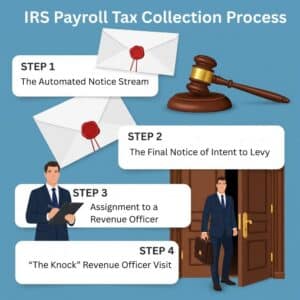
1) The Automated Notice Stream (The “CP” Letters)
The collections process doesn’t start with an agent; it starts with a computer. The IRS Automated Collection System (ACS) will begin sending a series of notices, each one more serious than the last.
- CP501 – We Have a Balance Due: This is typically the first gentle reminder that a tax debt exists.
- CP503 – Second Reminder: The language becomes more firm, emphasizing the need to pay immediately.
- CP504 – Urgent Notice: Intent to Levy: This is a statutory notice required before the IRS can seize assets. It warns that the IRS can levy your state tax refund. This is your last warning before the case becomes much more serious.
Ignoring these notices is the worst thing you can do. It guarantees your case will escalate.
2) The Final Notice of Intent to Levy (Letter 1058/LT11)
After the CP504, the IRS will issue a “Final Notice of Intent to Levy and Notice of Your Right to a Hearing.” This is arguably the most important letter you can receive.
- 30-Day Deadline: This notice gives you 30 days to either pay the debt in full or formally appeal the proposed levy by requesting a Collection Due Process (CDP) hearing.
- Your Appeal Rights: A timely CDP request is critical. It legally stops the IRS from levying your assets while your appeal is pending, giving your attorney time to negotiate a resolution like an Installment Agreement or Offer in Compromise.
- The Danger of Inaction: If you miss this 30-day window, you forfeit your primary appeal rights, and the IRS is legally free to begin seizing your business’s bank accounts and accounts receivable.
3) Assignment to a Revenue Officer
If the debt is large or the automated notices are ignored, your case will be assigned from the centralized ACS to a local IRS Revenue Officer (RO). This moves the problem from a faceless computer system to a person whose job is to collect the tax from you directly.
- Increased Scrutiny: The Revenue Officer will conduct a thorough investigation into your business’s finances. They will demand financial statements (Form 433-B) and other sensitive information.
- Unannounced Visits: An RO can and will make unannounced visits to your place of business. Their goal is to assess your operations and pressure you into a payment plan.
- The Power to Levy and Seize: Revenue Officers have immense power. They can issue bank levies, seize accounts receivable, and in extreme cases, even seize physical business assets like property and equipment.
4) The Revenue Officer Visit: The “Knock at the Door”
The arrival of a Revenue Officer at your business is an incredibly stressful event. How you handle this interaction is critical.
- Be Professional, Not Confrontational: You are required to identify yourself, but you are not required to answer detailed financial questions or turn over records on the spot.
- Do Not Make Unrealistic Promises: Do not agree to a payment plan you cannot afford just to make the officer go away. Defaulting on a promise will make your situation much worse.
- Engage Representation Immediately: The most effective response is to state that your attorney will be contacting them. Politely take their card and contact your legal counsel right away. This shifts all future communication from you to your representative.
Why You Need a Tax Attorney for IRS Collections
Dealing with an IRS Revenue Officer is a high-stakes negotiation where you are at a significant disadvantage. An attorney levels the playing field.
- A) Immediately Stop Taxpayer Contact Once we file a Power of Attorney (Form 2848), the Revenue Officer is legally required to cease direct contact with you and communicate only with us. This protects you from being intimidated or making costly mistakes.
- B) Negotiate from a Position of Strength We understand the IRS’s internal rules and what they can and cannot do. We prepare the required financial disclosures and negotiate for the best possible resolution, whether it’s an installment agreement, an OIC, or proving the business cannot afford to pay right now.
- C) Prevent and Remove Levies If a levy has been issued, we can often negotiate to have it released. If a levy is threatened, we can use the appeal process and other strategies to prevent it from happening while we work out a solution.
FAQs for the IRS Collections Process
Q: How do I know if the person at my door is really from the IRS? A: An IRS Revenue Officer will always carry two forms of official credentials: a pocket commission and a federal HSPD-12 card. You have the right to ask to see both.
Q: Can the IRS really close my business down? A: While they prefer to keep a business operating so it can pay its taxes, in cases of repeated non-compliance, they can seize assets essential to your operation, effectively forcing you to close.
Q: What is a Federal Tax Lien? A: A lien is a public notice of the government’s legal claim against your property for a tax debt. It secures the debt and can severely damage your credit and ability to get financing. A levy is the actual seizure of property to satisfy the debt.
Q: How long can the IRS try to collect a tax debt? A: The IRS generally has 10 years from the date a tax is assessed to collect it. This is known as the Collection Statute Expiration Date (CSED).
Q: Will filing for bankruptcy stop a Revenue Officer? A: Yes, filing for bankruptcy triggers an “automatic stay,” which temporarily halts all IRS collection actions, including those by a Revenue Officer. However, payroll trust fund taxes are typically not dischargeable in bankruptcy.
Final Note:
The IRS collections process is designed to systematically increase pressure on a business owner until the tax is paid. Ignoring the problem will only lead to more severe consequences. The moment you receive a notice—and especially if a Revenue Officer is assigned—it is time to seek professional legal help to protect your business and your assets.
If you Received an Audit Notice, Don’t Panic Contact your sales tax professional, or reach out to Tax Law Offices, Inc. (StopIRSproblem.com) for help. Ask for a 30-minute consultation to see if you need representation.